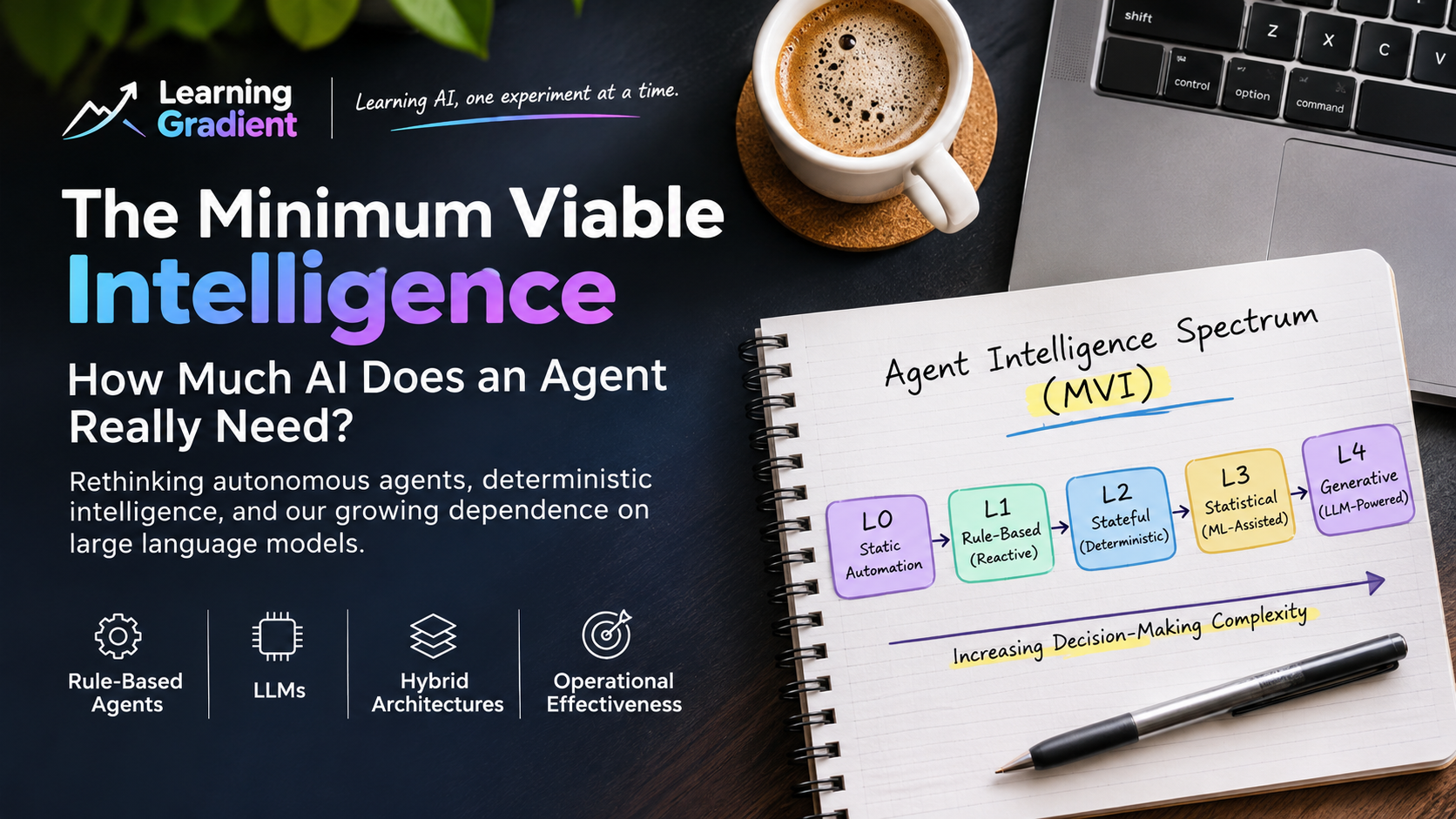
Rethinking autonomous agents, deterministic intelligence, and our growing dependence on large language models.
Are We Asking the Wrong Question?
Whenever we discuss building an AI agent today, the conversation usually begins with questions like:
- Which LLM should we use?
- Which agentic framework should we choose?
- How do we manage context, memory and tool calling?
But there is a more fundamental question that we rarely ask.
Does this agent actually need an LLM?
Somewhere along the journey from traditional automation to generative AI, we started associating intelligence almost exclusively with language models.
The ability to reason in natural language has become so impressive that we sometimes overlook simpler mechanisms capable of solving the same problems.
As engineers, perhaps our responsibility is not to maximize intelligence but to determine how much intelligence is actually necessary.
This brings me to a concept I would like to explore: Minimum Viable Intelligence (MVI).
Intelligence, Autonomy and Adaptability Are Not the Same
Imagine two systems.
The first continuously monitors a database, identifies missing records, initiates a recovery process, verifies the results and resumes monitoring.
It does not use an LLM. It does not understand natural language. It operates entirely through predefined rules and feedback mechanisms.
The second system uses a powerful language model. It can interpret complex instructions, analyze logs and suggest corrective actions. However, it requires human approval before performing any operation.
Which system is more autonomous?
The answer might be the first.
Which system has greater general-purpose reasoning capabilities?
Probably the second.
This distinction matters because intelligence and autonomy are different architectural properties.
- Intelligence: The ability to interpret information and make appropriate decisions.
- Autonomy: The ability to operate independently within defined boundaries.
- Adaptability: The ability to respond to changing or unfamiliar conditions.
A system does not necessarily need advanced reasoning capabilities to achieve meaningful operational autonomy.
Understanding this distinction changes how we approach agent design.
Agents Existed Before Large Language Models
The concept of an intelligent agent is not a recent invention.
Classical artificial intelligence has explored autonomous agents, expert systems, knowledge representation and inference engines for decades.
In Artificial Intelligence: A Modern Approach, Stuart Russell and Peter Norvig describe multiple agent architectures.
| Agent Type | Decision-Making Mechanism |
|---|---|
| Simple Reflex Agent | Current observations and predefined rules |
| Model-Based Reflex Agent | Observations and internal state |
| Goal-Based Agent | Actions selected to achieve an objective |
| Utility-Based Agent | Decisions based on expected utility |
| Learning Agent | Behavior improved through experience |
None inherently requires a language model.
A simple reflex agent makes decisions based on its current observations and predefined conditions.
A model-based reflex agent extends this capability by maintaining an internal representation of its environment.
These architectures may appear less exciting than modern generative agents, but their underlying principles remain highly relevant to production engineering.
The LLM revolution expanded the capabilities of agents. It did not invent them.
Introducing Minimum Viable Intelligence
Minimum Viable Product, or MVP, is a familiar concept in software development.
Instead of building every possible feature, we identify the minimum functionality required to deliver meaningful value.
What if we applied a similar philosophy to intelligence?
I propose thinking about Minimum Viable Intelligence as an engineering principle:
An autonomous system should employ the least complex decision-making mechanism sufficient to achieve its objective reliably, safely and economically.
The emphasis here is on sufficiency, not simplicity at any cost.
A rule-based system that cannot handle its operational requirements is not necessarily a better architecture simply because it is cheaper.
Similarly, an LLM-powered system is not necessarily better because it possesses greater general-purpose capabilities.
The architecture should emerge from the problem.
Not the other way around.
This idea shares conceptual foundations with bounded rationality, satisficing and resource-aware decision-making. I am using MVI here as a practical design perspective for modern autonomous systems rather than claiming an entirely new scientific theory.
A Spectrum of Intelligence
Instead of dividing agents into rule-based and LLM-powered categories, we can consider different levels of decision-making capability.
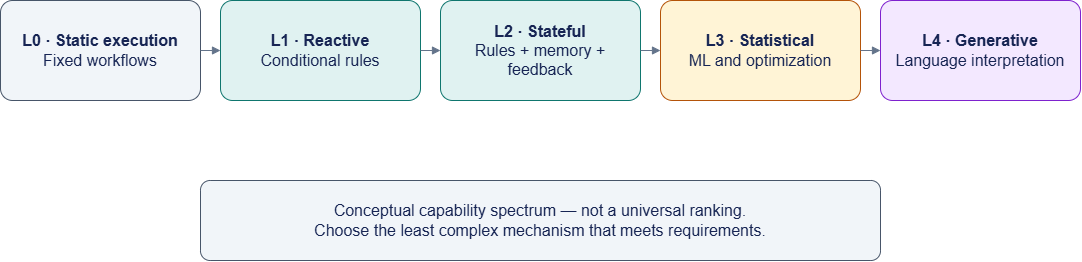
Figure 1: A conceptual spectrum of decision-making capabilities, from static automation to generative reasoning. Higher complexity does not necessarily imply greater operational effectiveness.
The proposed spectrum contains five categories.
| Level | Capability | Mechanism |
|---|---|---|
| L0 | Static Execution | Predefined workflows |
| L1 | Reactive Decisions | Conditional rules |
| L2 | Stateful Decisions | Rules, memory and feedback |
| L3 | Statistical Adaptation | Machine learning and optimization |
| L4 | Generative Reasoning | Large language models |
L0 — Static Execution
The system executes a predefined sequence of instructions.
A scheduled script that transfers data from one database to another is a simple example.
The system follows instructions rather than independently selecting a recovery strategy.
L1 — Reactive Intelligence
The system observes its environment and makes decisions using predefined conditions.
For example, restarting a service when a recognized failure condition occurs.
L2 — Stateful Intelligence
The system incorporates memory, operational state and feedback into its decision-making process.
It can track previous failures, evaluate retry limits, select appropriate recovery actions and verify outcomes.
L3 — Statistical Intelligence
The system uses statistical methods, machine learning or optimization techniques to identify patterns and support decisions.
An example would be detecting abnormal ETL execution times using historical runtime distributions.
L4 — Generative Reasoning
The system uses language models to interpret unstructured information, investigate unfamiliar situations and generate possible action plans.
These categories are illustrative, not a universal hierarchy of intelligence.
A statistical model may outperform an LLM in a specialized forecasting task. A deterministic engine may outperform both when evaluating a precisely defined compliance policy.
The objective is not to reach L4.
The objective is to identify the capabilities required by the problem.
If an L2 architecture satisfies all operational requirements, moving to L4 should require a meaningful engineering justification.
Rule-Based Agents: Intelligence Through Explicit Knowledge
Rule-based agents make decisions using explicitly defined domain knowledge.
Their fundamental principle is straightforward:
IF a condition is satisfied, THEN perform an appropriate action.
However, production-grade rule-based agents can be significantly more sophisticated than a collection of conditional statements.
They can incorporate operational state, rule priorities, dependency graphs, inference mechanisms and feedback loops.
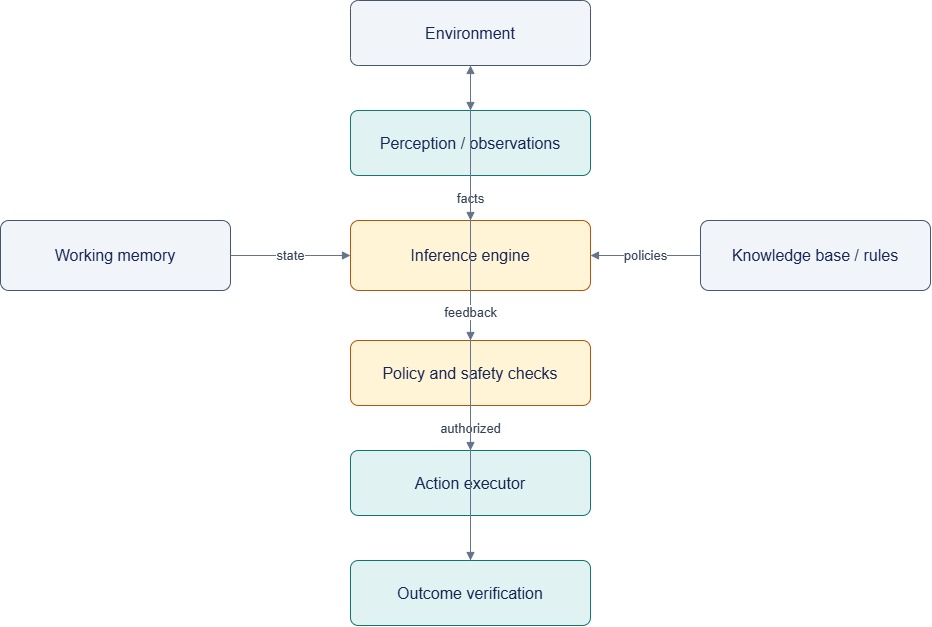
Figure 2: Architecture of a deterministic rule-based agent. Observations and explicit knowledge are processed by an inference engine, followed by governed execution and outcome verification.
Perception Layer
The perception layer observes the environment through databases, APIs, application logs, infrastructure metrics and system events.
Its responsibility is to transform environmental observations into information that the decision-making component can evaluate.
Knowledge Base
The knowledge base contains predefined rules, business logic, operational policies and domain-specific knowledge.
It represents what the system knows about its operating environment and the actions it is permitted to perform.
Inference Engine
The inference engine evaluates observations against the knowledge base and determines which actions should be performed.
When multiple rules are applicable, conflict-resolution strategies can determine which rule takes priority.
This is the core decision-making component of a rule-based agent.
Working Memory
Working memory maintains operational state, historical observations, previous actions and retry counts.
This allows the agent to make decisions based on more than its immediate observations.
Governance Layer
The governance layer ensures that selected actions comply with operational constraints.
It can enforce permissions, approval requirements, retry limits and safety policies.
Action Executor
The action executor interacts with external systems through APIs, scripts, database operations or approved workflows.
Feedback Mechanism
The feedback mechanism verifies whether the selected action achieved its intended outcome.
If the action fails, the agent can evaluate another permitted recovery strategy or escalate the problem.
Instead of asking a language model what action to perform, the agent evaluates the available facts against established policies.
Given identical observations, state and configuration, a deterministic inference engine produces the same decision.
This characteristic is particularly valuable in environments where reproducibility, auditing and operational safety matter.
However, deterministic intelligence does not imply that the entire system is predictable. External services, changing data and infrastructure failures can still introduce uncertainty.
The advantage is that the decision-making policy itself can be explicitly understood and tested.
Is a Rule-Based Agent Just Another Automation Script?
This is an important question.
If a rule-based agent uses conditional statements, what makes it different from traditional automation?
The distinction is not always sharp. A sufficiently sophisticated automation system can also exhibit agent-like behavior.
Consider the difference between executing a predefined task and continuously maintaining a desired operational state.
| Characteristic | Basic Automation | Stateful Rule-Based Agent |
|---|---|---|
| Objective | Execute a task | Maintain an operational objective |
| Execution | Predefined sequence | Condition-driven actions |
| Environmental Awareness | Often limited | Explicit observation |
| Decision-Making | Fixed instructions or branches | Rule evaluation |
| State Management | Often limited | Operational memory |
| Recovery | Predefined error handling | Situation-dependent recovery |
| Feedback | Optional | Integral to the control loop |
A scheduled script that restarts a service every night executes a predefined task.
A system that observes service health, determines whether recovery is necessary, selects an approved recovery action and verifies the outcome exhibits a greater degree of autonomous behavior.
Both may use the same programming language.
Both may use conditional statements.
The difference lies in their architecture and operational responsibilities.
An agent is not defined by the presence of an LLM, nor does simply calling an automation script an agent make it one.
Industry Has Already Embraced Deterministic Autonomy
Interestingly, many industries have been implementing these principles without necessarily calling their systems AI agents.
Kubernetes and the Reconciliation Loop
Kubernetes controllers continuously compare the desired state of a system with its observed state.
If an application requires three replicas and only two are running, the controller initiates corrective actions to restore the desired state.
It does not need to understand natural language.
It does not need to generate a recovery strategy from scratch.
The objective is known, the discrepancy is observable, and the corrective mechanism is established.
This is a powerful example of deterministic autonomy.
Cloud Infrastructure and Automated Remediation
AWS Config can evaluate cloud resources against predefined compliance rules and initiate configured remediation workflows.
A noncompliant resource can trigger an approved corrective action without requiring generative reasoning.
The intelligence is embedded in the policies, constraints and remediation mechanisms.
Banking and Financial Services
Financial institutions can use rule-based systems to evaluate transactions against predefined risk and compliance policies.
When certain conditions are satisfied, a system may initiate additional verification or escalate the transaction for investigation.
Machine learning can complement these mechanisms when identifying previously unknown patterns.
Manufacturing and Industrial Control
Industrial systems continuously monitor operational parameters such as temperature, pressure and equipment health.
When predefined safety boundaries are violated, control systems can initiate corrective actions or shut down equipment.
In such environments, predictable behavior can be more valuable than flexible reasoning.
Cybersecurity and Automated Response
Security orchestration and automated response systems can execute predefined playbooks when security incidents are detected.
Depending on organizational policies, these systems may isolate affected endpoints, restrict access or escalate incidents for investigation.
The response is determined by established security policies rather than necessarily being generated by a language model.
These systems are not all classified as AI agents. Nevertheless, they demonstrate the architectural principles of observation, decision-making, action and feedback.
A Data Engineering Perspective
Coming from a data engineering perspective, one of the most interesting applications of deterministic autonomy is ETL reconciliation and automated recovery.
Consider a common problem: maintaining consistency between an operational database and a data warehouse.
Suppose the source contains 10,000 records while the warehouse contains 9,850.
A conventional monitoring system might detect the discrepancy and notify an engineer.
A stateful rule-based agent could go further.
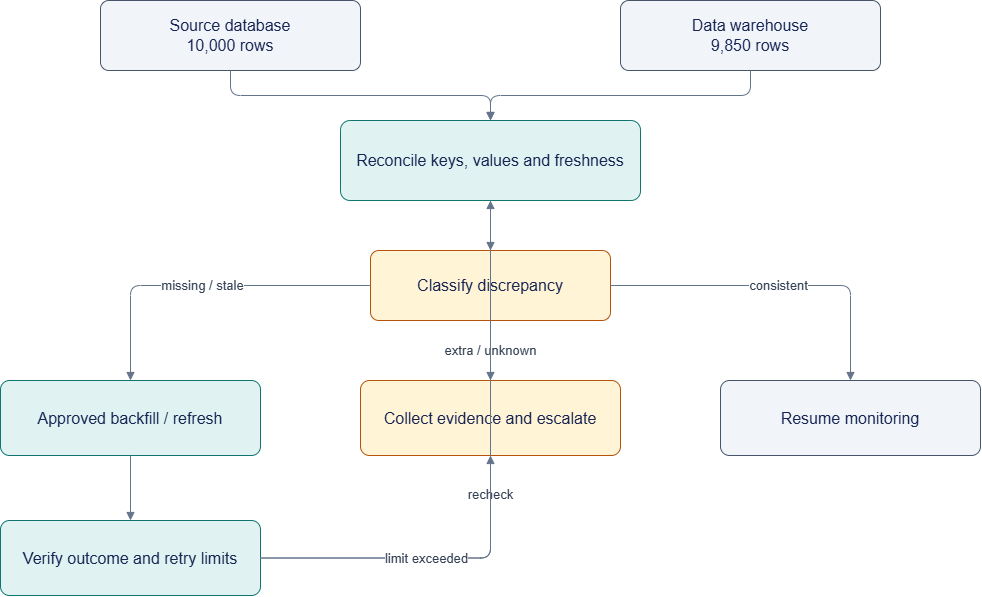
Figure 3: An illustrative closed-loop ETL reconciliation architecture that detects discrepancies, selects authorized remediation actions and verifies the resulting data without LLM involvement.
The agent could perform the following operations:
- Detect the discrepancy.
- Validate data freshness and comparison boundaries.
- Identify missing records.
- Evaluate the applicable recovery policy.
- Trigger an authorized backfill.
- Verify the resulting data.
- Escalate the incident if recovery fails.
The entire process operates as a closed feedback loop.
A simplified decision table might look like this:
| Observed Condition | Agent Decision |
|---|---|
| Missing records confirmed | Trigger authorized backfill |
| Stale records detected | Execute approved refresh |
| Unexpected extra records | Identify and escalate |
| Recovery successful | Validate and resume monitoring |
| Retry limit exceeded | Notify an engineer |
| Unknown discrepancy | Collect evidence and escalate |
There is no inherent requirement for an LLM.
Of course, production reconciliation is more complex than comparing record counts.
Two databases can contain the same number of records while having completely different identifiers or attribute values.
A production-grade reconciliation agent may therefore require:
- Primary-key comparisons.
- Row-level hash comparisons.
- Data freshness validation.
- Watermark alignment.
- Transformation-aware validation.
- Dependency management.
- Idempotent recovery mechanisms.
But these requirements do not automatically introduce the need for generative reasoning.
The agent already has a clearly defined objective, observable environmental state, known recovery mechanisms and a feedback loop.
Introducing an LLM into this architecture should depend on whether it solves a problem that the existing decision-making mechanisms cannot adequately address.
The intelligence resides in how we design the system.
The Hidden Cost of Intelligence
Intelligence is not free.
Every additional decision-making capability introduces engineering trade-offs.
An LLM-powered agent may introduce considerations such as:
- Model inference costs.
- Additional decision latency.
- Nondeterministic outputs.
- Hallucinations and incorrect tool selection.
- Model availability dependencies.
- Evaluation and governance complexity.
Rule-based systems have their own costs:
- Increasing rule complexity.
- Conflicts between overlapping rules.
- Limited adaptability.
- Continuous knowledge-base maintenance.
- Difficulty handling unfamiliar situations.
The relevant question is not which architecture has fewer disadvantages.
It is which architecture delivers the required operational outcome at an acceptable total cost and risk.
Introducing the Intelligence Budget
We can think of this as an intelligence budget.
Just as engineers consider infrastructure budgets, latency budgets and reliability targets, we can evaluate the cost of introducing additional decision-making capabilities.
| Dimension | Engineering Question |
|---|---|
| Computational Cost | How expensive is each decision? |
| Latency | How quickly must the agent respond? |
| Reliability | How consistently does it resolve problems? |
| Explainability | Can we understand why an action was selected? |
| Adaptability | Can it handle unfamiliar situations? |
| Maintenance | How much effort is required to maintain the decision mechanism? |
| Governance | Can we control and audit its actions? |
| Operational Risk | What happens when it makes an incorrect decision? |
Every additional layer of intelligence should justify its existence through measurable improvements in reliability, adaptability, efficiency or operational coverage.
Otherwise, we may be introducing complexity without introducing proportional value.
The intelligence budget is not simply about reducing token consumption.
A deterministic system with thousands of difficult-to-maintain rules could become more expensive to operate than an appropriately designed model-assisted system.
The objective is to optimize the total engineering cost of achieving the desired outcome.
When Does an LLM Become Valuable?
Imagine two operational failures.
Scenario 1: A Known Operational Failure
An ETL pipeline encounters a known database connection timeout.
The recovery procedure is already documented.
Retry the operation within approved limits, verify connectivity and escalate if the failure persists.
A deterministic agent can execute this policy.
The problem is structured, the conditions are known and the recovery mechanism is established.
Introducing an LLM may provide little additional operational value.
Scenario 2: An Unfamiliar Operational Failure
The pipeline fails because of an unfamiliar interaction between a recent code deployment, a schema change and multiple dependent services.
The available information is distributed across logs, documentation and source code.
Here, an LLM may provide meaningful value by:
- Interpreting unstructured error logs.
- Connecting relevant observations.
- Examining technical documentation.
- Investigating code changes.
- Proposing a possible root cause.
- Suggesting potential recovery strategies.
The distinction is not between intelligent and unintelligent systems.
It is between problems with established decision policies and problems that benefit from flexible contextual interpretation.
Even in the second scenario, an LLM-generated recommendation should not automatically become an authorized action.
Reasoning and execution can remain separate.
What Happens When the Intelligence Provider Disappears?
Consider another architectural question.
If the LLM powering an autonomous agent becomes unavailable, what happens to the system?
- Does it stop functioning entirely?
- Can it still execute established recovery procedures?
- Can it continue monitoring its environment?
- Can it safely escalate unfamiliar problems?
An external model provider may become unavailable for several reasons.
Network failures, service outages, rate limits, exhausted quotas or authentication failures can interrupt access to generative reasoning capabilities.
Should these failures also prevent an agent from executing recovery procedures that have already been defined?
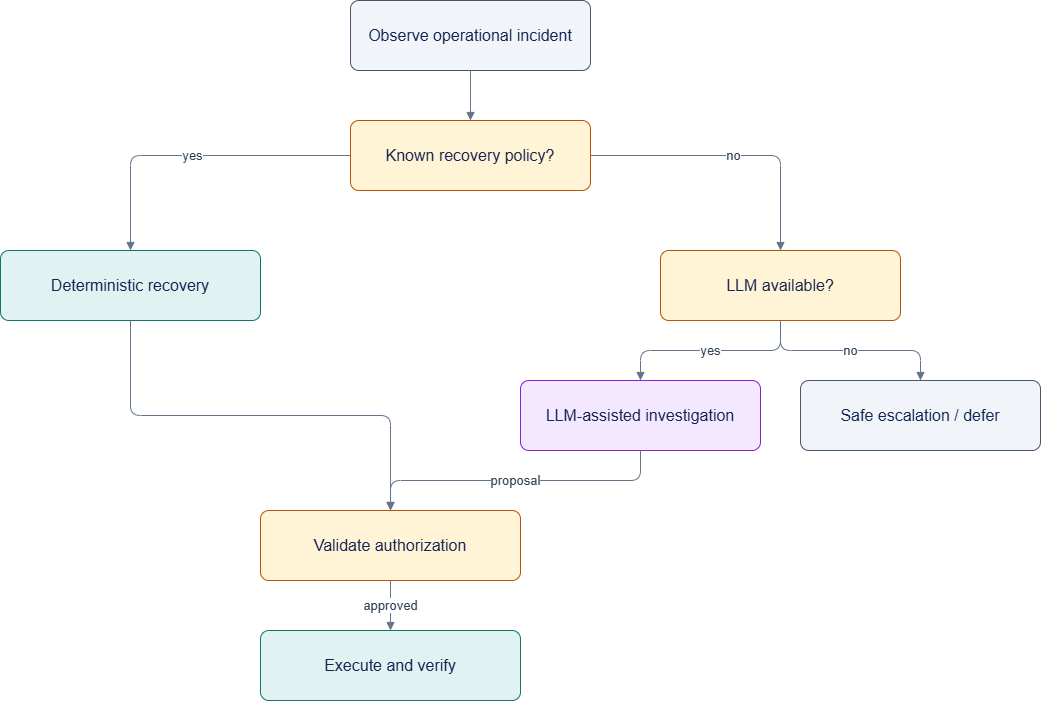
Figure 4: A resilient agent architecture in which essential deterministic operations can continue when an optional generative reasoning component becomes unavailable.
This is where deterministic foundations become particularly interesting.
An agent could continue performing essential operations using predefined policies even when its generative reasoning component is unavailable.
Known incidents could still be resolved automatically.
Unfamiliar incidents could be recorded, queued for investigation or escalated to a human operator.
The LLM becomes an optional capability rather than a mandatory operational dependency.
This introduces the principle of graceful degradation.
Instead of losing all operational capabilities when a model becomes unavailable, the system temporarily operates within a more restricted set of capabilities.
This architecture will not suit every application, especially those fundamentally dependent on natural language understanding.
But for many industrial systems, separating essential operational behavior from optional generative reasoning could improve resilience.
A resilient autonomous system should understand not only how to act intelligently, but also how to operate safely when some of its intelligence becomes unavailable.
Towards Hybrid Intelligence
Perhaps the future of industrial agents is not a competition between deterministic systems and language models.
Perhaps it is a combination of both.
Imagine an agent that first evaluates whether an observed problem matches a known operational scenario.
If it does, the deterministic engine executes the appropriate recovery policy.
If it does not, the system can use statistical models or an LLM-assisted component to investigate the problem and propose possible actions.
Those actions then pass through a deterministic governance layer before execution.
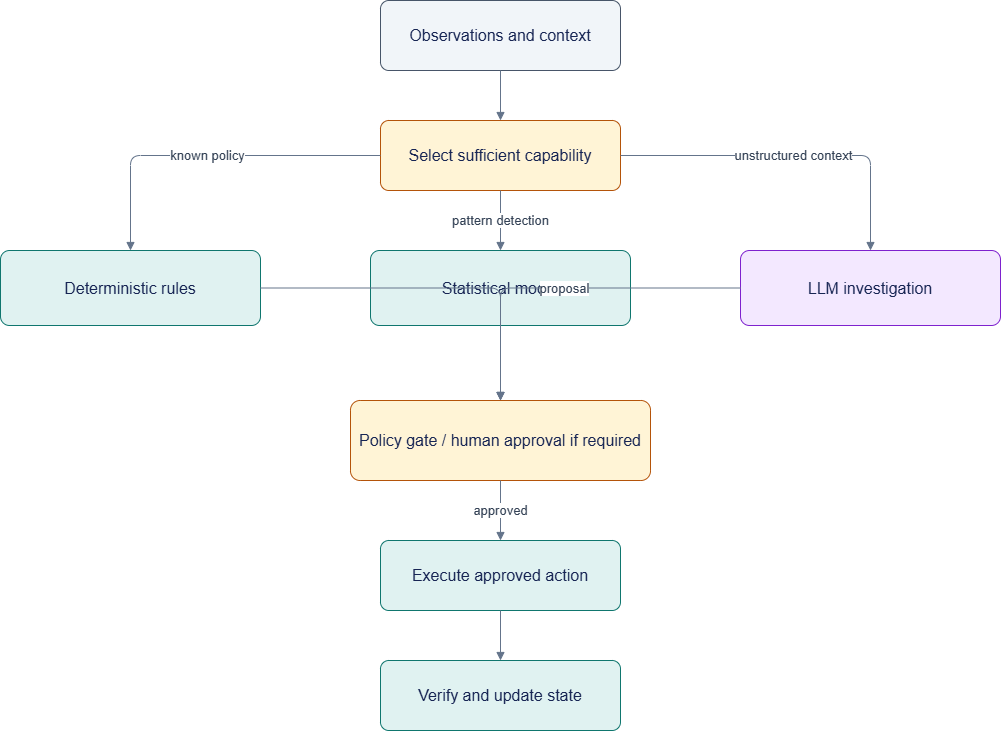
Figure 5: A hybrid agent architecture combining deterministic rules, statistical intelligence and optional generative reasoning within a governed execution framework.
The system uses flexible reasoning where it is valuable and explicit control where it is necessary.
This creates a separation of responsibilities.
| Component | Responsibility |
|---|---|
| Rule-Based Engine | Operational predictability and known decision policies |
| Statistical Models | Pattern recognition, forecasting and anomaly detection |
| Language Models | Contextual interpretation and flexible investigation |
| Governance Layer | Permissions, constraints and execution boundaries |
| Action Executor | Interaction with external systems |
| Feedback Mechanism | Outcome verification |
| Human Operator | Oversight and unresolved incident handling |
Each component contributes a specific capability rather than attempting to solve every problem.
This approach also allows organizations to introduce intelligence incrementally.
An organization could begin with a deterministic reconciliation agent, introduce statistical anomaly detection when historical data becomes available and integrate an LLM-assisted investigation component when unfamiliar operational problems justify it.
The entire architecture does not necessarily need to be redesigned whenever a new reasoning capability is introduced.
The decision-making mechanisms can evolve while the operational objectives, governance policies and execution interfaces remain relatively stable.
Intelligence should be an architectural capability, not an unquestioned dependency.
Designing Agents From the Problem Backwards
Before selecting an agentic framework or a language model, I believe engineers should ask:
- What objective must the agent achieve?
- What information does it need to observe?
- Can its decisions be expressed through explicit policies?
- What degree of uncertainty exists in the environment?
- What are the consequences of an incorrect action?
- What additional value would a language model provide?
- Can a simpler architecture achieve the same operational outcome?
- What happens if the decision-making component becomes unavailable?
- How will the system verify whether its actions were successful?
These questions shift the conversation from technology selection to architectural reasoning.
A practical decision framework could look like this:
| Problem Characteristics | Potential Architecture |
|---|---|
| Fixed instructions and predictable execution | Traditional automation |
| Known conditions and established actions | Reactive rule-based agent |
| State-dependent decisions and recovery | Stateful rule-based agent |
| Historical patterns and numerical uncertainty | Statistical or ML-assisted agent |
| Unstructured information and unfamiliar problems | LLM-assisted agent |
| Mixed operational requirements | Hybrid agent |
These are starting points rather than strict architectural rules.
Sometimes the answer will be a deterministic agent.
Sometimes it will be a statistical model.
Sometimes it will be an LLM-powered system.
And sometimes it will be a combination of all three.
The architecture should be evaluated against operational requirements rather than the popularity of a particular technology.
Where Minimum Viable Intelligence Falls Short
Minimum Viable Intelligence should not become an argument for avoiding advanced AI capabilities.
There are environments where predefined rules cannot adequately represent the complexity of the problem.
There are situations where maintaining thousands of rules becomes impractical.
There are applications where natural language understanding is the primary requirement.
And there are problems where learning and adaptation are essential rather than optional.
In these situations, a more sophisticated decision-making mechanism may represent the minimum viable intelligence.
The word minimum should therefore be understood in relation to the requirements of the problem.
It does not mean choosing the cheapest mechanism.
It does not mean avoiding machine learning.
It does not mean rejecting large language models.
It means avoiding unnecessary complexity while ensuring that the system possesses the capabilities required to achieve its objective.
The proposed framework is a design philosophy. Its practical effectiveness would need to be evaluated through controlled experiments and real-world operational measurements.
Final Thoughts
We are living through an exciting period in artificial intelligence.
Large language models have unlocked capabilities that were previously difficult to implement.
But as engineers, we should be careful not to confuse technological capability with architectural necessity.
Not every problem requires reasoning in natural language.
Not every autonomous system requires generative intelligence.
Not every agent needs an LLM.
The most sophisticated architecture is not necessarily the one containing the most sophisticated model.
It may be the one that understands exactly where sophistication is required.
Minimum Viable Intelligence is ultimately an invitation to rethink how we design autonomous systems.
Instead of asking:
How intelligent can we make this agent?
Perhaps we should start asking:
How intelligent does this agent actually need to be?
Don't maximize intelligence. Optimize for sufficient intelligence.
Frequently Asked Questions
Do AI agents need an LLM?
No. Autonomous agents can use deterministic rules, state machines, statistical models or other decision-making mechanisms without requiring a large language model.
What is Minimum Viable Intelligence (MVI)?
Minimum Viable Intelligence is a proposed engineering philosophy that advocates using the least complex decision-making mechanism sufficient to achieve an operational objective reliably, safely and economically.
What is a rule-based agent?
A rule-based agent observes its environment, evaluates predefined rules, selects appropriate actions and may verify their outcomes through feedback mechanisms.
When should an agent use an LLM?
An LLM becomes valuable when an agent needs to interpret unstructured information, investigate unfamiliar problems or perform flexible contextual reasoning.
Can rule-based agents and LLMs work together?
Yes. Hybrid agents can combine deterministic rules for predictable operations with LLM-assisted reasoning for unfamiliar scenarios, while enforcing explicit governance and execution policies.
References and Further Reading
- Stuart Russell and Peter Norvig — Artificial Intelligence: A Modern Approach.
- Herbert A. Simon — A Behavioral Model of Rational Choice (1955).
- Jeffrey O. Kephart and David M. Chess — The Vision of Autonomic Computing (2003).
- Kubernetes Documentation — Controllers.
- AWS Config — Remediating Noncompliant Resources.
- Kubernetes Documentation — Self-Healing.
Disclaimer: The Minimum Viable Intelligence framework presented in this article is a conceptual engineering perspective inspired by established ideas in artificial intelligence, bounded rationality and autonomic computing. It is not an empirically validated intelligence hierarchy or a claim of scientific novelty. The operational scenarios and architecture diagrams are illustrative.
About the author
- AI, Data Science, and ML are my playground. I turn workplace challenges, lessons, and "why is this model behaving like that?" moments into articles. Every post reflects my experience, and honestly, it's also my way of showing myself that I know what I'm doing.
Comments
Join the discussionThe L0 to L4 spectrum is a useful way to have this argument. We see the same split in software work: the model writes the code, but who scopes it, who reviews it and when a person signs off work better as fixed steps than as something the model decides each time. Where would you put that layer on your spectrum?